

Notes on Bibliophilia
In honor of Walter Benjamin's 134th birthday yesterday, I'm sharing a personal response to the writer and thinker's short essay from 1931 "Unpacking My Library"

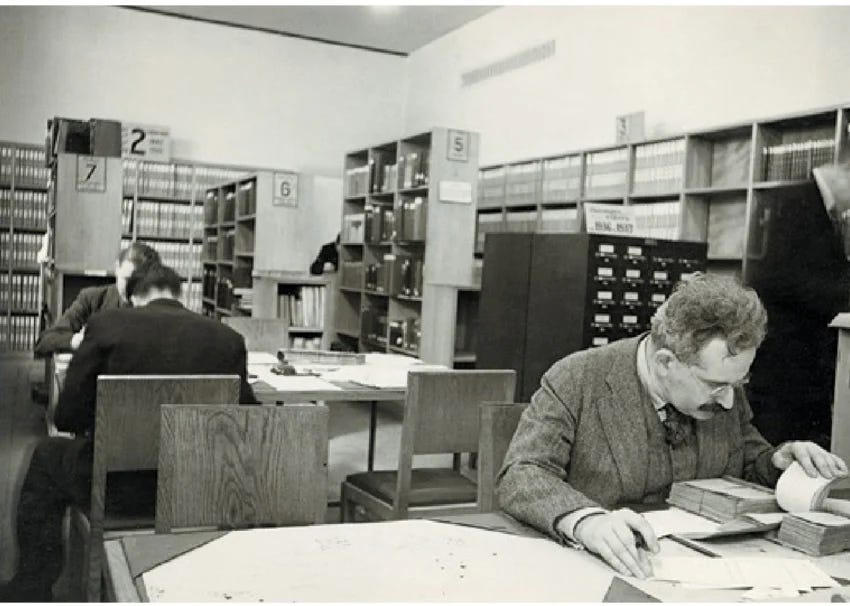
A number of years ago I wrote a story about a man who, in part to avoid confronting a deteriorating relationship and in part to armor himself against the onslaught of a bitter winter in Berlin, retreats into his books: not by reading them, but by endlessly sorting and cataloguing them. At the time, I felt with suffocating intensity that I had barricaded myself in my Kreuzberg apartment with books. Like the story that grew out of it, that claustrophobia was a manifestation of my larger fear of getting stuck in Berlin.
...
Book collecting is ill-suited to a nomadic existence. A library is a highly unportable thing. There is perhaps no greater illustration of this truth than the scene in “Take the Money and Run” where Woody Allen works as a door-to-door encyclopedia salesman.
...
Though in recent years I have put distance between myself and Berlin, the city still has me – and hundreds of my books - in its grip. Now my library is scattered across bookshelves (a word I at first misspelled, rendering it “bookselves,” which is a lovely neologism) in Berlin, Munich, Italy and New York, which makes it impossible for me to ever find anything.
...
Through I’ve spent much of my life hunting for books, my library is not particularly valuable. I mostly go for old paperbacks: a British series of pocket Penguins from the 70s with works of modern art on their covers; brightly colored Vintage Contemporaries from the 80s; somber Vintage Modern Classics, with their durable spines and matte covers, from the 90s. On the shelf, my books are a jumble of irregular shapes, colors and sizes. My wife complains about their lack of uniformity. It offends her Italian design sensibilities. I tell her: That’s American individualism, baby.
...
When I began trading my pocket money for books, I frequented the street vendors on Broadway who marketed to an undergraduate crowd. The titles they laid out on their rickety folding tables looked like a subversive version of Columbia’s core curriculum: Augustine, Gertrude Stein, Franz Kafka, and Frantz Fanon. I’d pick up a few badly scuffed paperbacks, thinking I could get a head start on college for a couple of bucks. There was one book seller with a funny scrunched up face, boxy black-rimmed glasses, a broad forehead and tufts of white hair, who looked like a supporting character in a Bukowski or Hunter S. Thompson book. He routinely got into heated conversations with passing students and professors about John Rawls and Ursula K. LeGuin. He claimed to have a Masters in Science Fiction from Columbia. I read that he died during the pandemic. Were his books buried with him?
...
Books with blemishes never bothered me. In time, I even came to appreciate the wear and tear, admiring the scars that previous owner(s) and the world at large had left on books that were, after all, designed to be portable, durable and cheap. They all, I realized, had a history. Sometimes there were clues – a dedication, an address, an ex libris stamp or sticker. More often, however, few traces remained, leaving me to puzzle at the stupefying set of circumstances that led to the encounter of my discovering a treasure in a cavernous warehouse in Middlebury, Vermont; a crawlspace in Kreuzberg whose shelves were sagging with mildewy volumes of hair-raisingly illustrated German cookbooks; or buried beneath a stack or romance novels in a Bombay’s Thieves’ Market. Clutching a long-sought book in my dusty hands, I often think: So much has conspired to bring us together.
...
Places, for me, are inseparable from the books I have found while exploring them. In Paris at 15, I picked up a French paperback of “Lolita” with a curly- haired redhead sucking a lollipop wrapped in plastic at one of the green kiosks along the Seine. In Istanbul at 23, I found Robbe-Grillet’s “Recollections of the Golden Triangle” in a palatial bookshop on Istiklal Caddesi. Abandoning my family during holidays in Jerusalem, I often descended into the musty basement annex of the Schatz Book Gallery, hidden in a small pedestrian road off King George Street, where I exhumed long out-of-print novels by Italo Svevo and Alberto Moravia.
...
The keen pleasure of acquiring books I discovered as an adolescent, and which has since accompanied me through life, has recently taken on a morbid tinge. For years, a veteran New York Times’ editor I’ll call Dick invited me over to his house in Chappaqua, a second home which, he half-joked, he could never leave, because of his library of 5,000 books. I never found the time for a jaunt to Westchester before he died from Covid in the autumn of 2021. On my last trip to New York, we had dinner in Westchester with Dick’s widow, whom I’ll call Pat. We sat outside by the gravel driveway, enjoying cold salmon as Pat’s bulldogs, Lucy and Ethel, barked incessantly. After dinner, Pat ushered me inside the house. “Così fan tutte” was faintly playing on the radio as she led me to the living room and told me I was free to take anything I wanted.
The books were meticulously ordered on dark oak bookcases, the occasional exhibition poster poking out from any free wall space. I took down several tomes from the History and Philosophy sections somewhat sheepishly. Would Pat let me abscond with the rare first English edition of The Arcades Project?
Driving back to Manhattan, I glanced at the paper bag full of Dick’s books on the seat next to me. Gone was the excitement I had felt an hour earlier when I had made my pile. In its place was a sense of despair, even panic, at knowing that someday my library will, like Dick’s, be dispersed. If there are any readers left by then, I hope that the books that I loved and that will outlive me are will not be too brittle, cracked or faded to seduce and enchant anew.
-Adam Joachim Goldmann
This version of this text was originally delivered as a talk in Berlin in October 2024 as part of Lettrétage’s event “Walter Benjamin in the “Sphere of Life.”
You can find Benjamin’s “Unpacking my Library” from 1931 here.